The Madhyamaheshwar Trek does not require you to be a marathon runner or an experienced mountaineer. It does, however, require your body to handle several hours of walking, repeated uphill effort, uneven mountain paths, and a long descent after your legs are already tired.
That is why simply saying, “I walk sometimes, so I should be fine,” is not the best preparation.
A useful Madhyamaheshwar Trek fitness plan should train you for what you will actually do on the trail: walk steadily, climb without repeatedly burning yourself out, maintain balance on uneven ground, carry a practical daypack, and recover well enough to continue the next day.
This 30-day training plan is designed around those requirements.
If you already walk, exercise, cycle, or play sports regularly, 30 days can be a useful preparation period. If you currently have a very sedentary lifestyle, one month can still improve your fitness, but you should not treat 30 days as a guarantee that you will automatically be trek-ready.
Your starting fitness matters.
Your health matters.
And gradual progress matters much more than completing the hardest workout possible.
Safety note: This is a general fitness-preparation guide, not individual medical advice. If you have a heart, lung, joint, balance, blood-pressure, or other medical condition, or you are returning from an injury or surgery, speak with an appropriate healthcare professional before beginning strenuous trek training.
What Fitness Do You Actually Need for Madhyamaheshwar?
The most important fitness requirement is endurance, not speed.
You need enough cardiovascular and muscular endurance to continue walking after the excitement of the first hour has disappeared.
Your training should therefore focus on five areas:
walking endurance;
uphill and stair-climbing capacity;
leg and core strength;
balance and downhill control;
recovery between longer sessions.
You do not need to memorize every kilometer of the trek to understand this training plan. Route-specific information already has its own dedicated guide.
Before beginning your preparation, review the Madhyamaheshwar Trek route from Ransi to the temple so you understand why sustained walking and climbing deserve more attention than short bursts of intense exercise.
Is 30 Days Enough to Prepare for the Madhyamaheshwar Trek?
For someone who is already reasonably active, 30 days can be enough to improve trek-specific fitness significantly.
For a complete beginner, it is better to think differently:
Thirty days is enough to start meaningful preparation, but your final readiness should be based on how your body responds rather than the number of days completed.
For example, someone who already walks 45 minutes five days a week may progress comfortably toward longer walks and stair sessions.
Someone who becomes exhausted after 15 minutes of walking should begin more gradually and may need longer than one month.
Do not force both people into the same training volume.
If your main question is whether the trail itself is easy, moderate, or suitable for beginners, use the separate Madhyamaheshwar Trek difficulty guide. This article stays focused specifically on physical preparation.
A Simple Fitness Check Before Day 1
Before starting, assess your current condition.
Ask yourself:
Can I walk continuously for 30 minutes?
Can I climb several flights of stairs without severe discomfort?
Do my knees hurt during normal stair descent?
Have I exercised consistently during the last three months?
Can I perform basic squats and step-ups comfortably?
Do I have any recent injuries?
Does physical exertion cause unusual breathlessness, dizziness, chest discomfort, or other concerning symptoms?
This is not a pass-or-fail test.
It simply helps you choose the right starting intensity.
If You Are Already Active
Follow the full plan but keep most sessions at a sustainable effort.
If You Are Currently Sedentary
Reduce the first two weeks by approximately 20–30% and progress only when the previous level feels manageable.
Never try to “make up” missed workouts by doubling the next session.
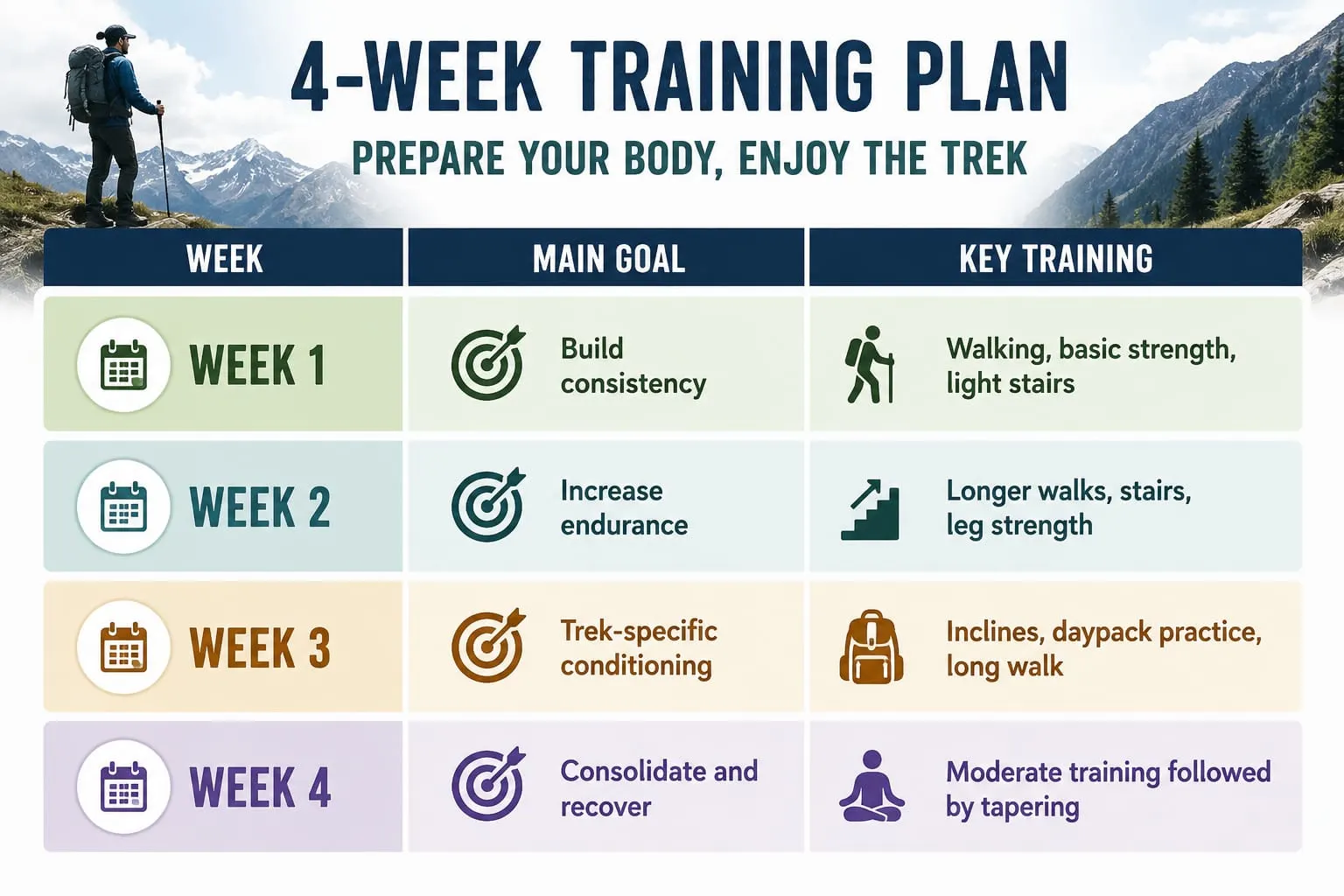
30-Day Madhyamaheshwar Trek Training Plan at a Glance
Week | Main Goal | Key Training |
|---|---|---|
Week 1 | Build consistency | Walking, basic strength, light stairs |
Week 2 | Increase endurance | Longer walks, stairs, leg strength |
Week 3 | Trek-specific conditioning | Inclines, daypack practice, long walk |
Week 4 | Consolidate and recover | Moderate training followed by tapering |
The plan intentionally emphasizes walking rather than forcing everyone to run.
Running can improve cardiovascular fitness, but it is not compulsory for a walking-based Himalayan trek.
Week 1: Build Your Walking Base
The first seven days are about consistency.
Do not try to prove your fitness during Week 1.
Day 1 – Baseline Walk
Walk continuously for 30–40 minutes at a comfortable pace.
You should feel that you are exercising, but you should still be able to speak in complete sentences.
Pay attention to:
breathing;
foot comfort;
knee discomfort;
ankle stability;
overall fatigue.
Day 2 – Basic Strength
Complete two controlled rounds of:
10–12 bodyweight squats;
8 reverse lunges per leg;
10 step-ups per leg;
15 calf raises;
12 glute bridges;
20–30 second plank.
Do not chase repetition numbers.
Good movement is more useful than poor-form high-volume training.
Day 3 – Brisk Walk
Walk for 35–45 minutes.
Increase the pace slightly compared with Day 1, but remain controlled.
Day 4 – Recovery
Take a relaxed 20–30 minute walk or a full rest day.
Day 5 – Walking + Stairs
Complete:
25–30 minutes of walking;
10–15 minutes of easy stair climbing.
Climb steadily rather than racing upward.
Day 6 – Longer Walk
Walk continuously for 50–60 minutes.
This is your first endurance-focused session.
Day 7 – Rest
Give your legs time to recover.
If Week 1 leaves you exhausted for several days, do not increase the workload yet.
Repeat a similar week instead.
Week 2: Improve Stair and Walking Endurance
Week 2 introduces more sustained climbing and slightly longer activity.
Day 8 – 45-Minute Brisk Walk
Maintain a comfortable but purposeful pace.
Use gentle hills if available.
Day 9 – Leg and Core Strength
Complete two or three rounds of:
12 squats;
8–10 reverse lunges per leg;
12 step-ups per leg;
15–20 calf raises;
12 glute bridges;
bird-dogs or a basic plank.
Day 10 – Stair Session
Spend 15–20 minutes climbing stairs at a controlled pace.
You do not need to count floors obsessively.
Time spent climbing steadily is more useful for this plan.
Day 11 – Recovery Walk
Walk easily for approximately 30 minutes.
Day 12 – Walk + Strength
Complete a 30-minute walk followed by a lighter version of your strength routine.
Day 13 – Endurance Day
Walk for 70–90 minutes.
If possible, choose a route with gentle slopes.
Do not worry about speed.
Your goal is to remain consistent from beginning to end.
Day 14 – Rest
Take a full recovery day.
By now, your normal 30–40 minute walk should ideally feel easier than it did on Day 1.
Week 3: Make Training More Trek-Specific
Week 3 should be your strongest training week.
That does not mean it should be reckless.
You are now combining longer walking with climbing, strength, and the equipment you expect to use.
Day 15 – Incline or Stair Training
Complete:
15-minute easy warm-up walk;
20–25 minutes of stairs or incline;
10-minute easy cool-down.
Day 16 – Strength Session
Complete three controlled rounds of:
12–15 squats;
10 reverse lunges per leg;
12–15 step-ups per leg;
20 calf raises;
12 glute bridges;
core stability exercise.
Day 17 – 60-Minute Brisk Walk
Walk for approximately one hour.
Keep your effort sustainable.
Day 18 – Recovery
Rest or complete an easy 20–30 minute walk.
Day 19 – Daypack Practice
Wear the backpack you expect to use on the trek and walk for 45–60 minutes.
Carry only a realistic trail load.
This session is not about proving that you can carry the heaviest bag possible.
Use it to evaluate:
shoulder comfort;
backpack fit;
strap adjustment;
posture;
balance;
access to water;
rubbing or pressure points.
Day 20 – Long Trek Simulation
Complete approximately 90–120 minutes of continuous activity.
If you have access to hills, use them.
If you live in a flat city, combine ordinary walking with repeated stairs or treadmill incline.
Wear your actual trekking footwear.
Maintain a pace that you could continue beyond the end of the session.
Day 21 – Easy Consecutive-Day Walk
Walk for 40–50 minutes at an easy pace.
This session matters because trekking is not always performed with completely fresh legs.
It gives you a small taste of walking again after the previous day's longer effort.
Week 4: Consolidate Your Fitness and Reduce Fatigue
The final week should not be your hardest.
You have very little to gain from exhausting yourself immediately before traveling.
Day 22 – Light Strength
Complete two moderate rounds of your usual exercises.
Day 23 – Incline Session
Walk for approximately 40–50 minutes, including 15–20 minutes of stairs or incline.
Day 24 – Steady Walk
Complete a comfortable 45–60 minute walk.
Day 25 – Recovery
Rest or walk easily.
Day 26 – Final Longer Session
Walk for approximately 60–90 minutes at an easy-to-moderate pace.
Finish feeling that you could have continued.
Do not turn this into a final fitness examination.
Day 27 – Easy Movement
Take a 30-minute relaxed walk.
Add gentle mobility if it feels comfortable.
Day 28 – Rest
Avoid heavy leg training.
Day 29 – Short Easy Walk
Walk for 20–30 minutes in your trekking shoes.
Day 30 – Recovery and Preparation
Rest.
Focus on:
sleep;
normal balanced meals;
appropriate hydration;
travel preparation;
checking footwear and equipment.
The objective is to reach the trail with fresh legs.
Best Strength Exercises for Madhyamaheshwar Trek Preparation
You do not need complicated gym equipment.
Squats
Squats strengthen the quadriceps, glutes, and supporting muscles used repeatedly during uphill and downhill movement.
Step-Ups
Step-ups closely resemble the repeated action of climbing.
Use a stable platform.
Reverse Lunges
Reverse lunges help develop single-leg control and stability.
If balance is difficult, use a wall or railing for support.
Calf Raises
Your calves work constantly during uphill walking.
Calf raises are simple and easy to include.
Glute Bridges
Strong glutes help support hip movement during long walking sessions.
Core Stability
Your core helps maintain posture and balance, especially when carrying a backpack.
Planks and bird-dogs are sufficient for most beginners.
What If You Do Not Have Hills Near Home?
Living in Delhi, Mumbai, Bangalore, Kolkata, or another relatively flat urban environment does not prevent you from preparing.
Use:
apartment stairs;
office staircases;
stadium steps;
treadmill incline;
pedestrian bridges;
step-ups;
safe uphill roads where available.
The important factor is repeated, controlled climbing.
You do not need access to the Himalayas before your Himalayan trek.
Do You Need to Run 5 km Before Madhyamaheshwar?
No.
Running can be useful if you already run and enjoy it.
But a 5 km running benchmark should not be treated as mandatory for Madhyamaheshwar Trek preparation.
The activity you are preparing for is prolonged walking and climbing.
A person who can comfortably walk for 90–120 minutes, climb stairs steadily, recover well, and perform basic strength work may be better prepared for trekking than someone who can run quickly but has never trained for prolonged uphill walking.
If you already run, keep it.
If you do not run, do not suddenly begin an aggressive running program solely because your trek is one month away.
Train for the Descent Too
Most people prepare for the climb.
Do not forget the return.
Descending repeatedly requires muscular control, particularly from the quadriceps and supporting muscles around the knees, hips, and ankles.
During stair training, practice going down slowly and deliberately.
Do not rush downhill because your breathing feels easier.
Squats, step-ups, lunges, and controlled stair descent all contribute to better downhill preparation.
Break In Your Trekking Shoes Before the Trip
Your long training walks should double as footwear testing.
Do not wear brand-new trekking shoes for the first time when the actual trek starts.
Check:
heel movement;
toe pressure;
sock comfort;
rubbing;
hot spots;
ankle comfort.
For the rest of your equipment, clothing, rain protection, personal essentials, and trail gear, use the dedicated Madhyamaheshwar Trek packing list rather than turning your fitness plan into another packing article.
Recovery Is Training Too
More exercise is not automatically better preparation.
Your body adapts during recovery.
Try to maintain:
consistent sleep;
regular meals;
adequate protein and carbohydrates from your normal diet;
appropriate hydration;
at least one easier or rest day each week.
The World Health Organization recommends regular aerobic activity combined with muscle-strengthening activity for adults. However, general physical-activity guidelines are not a personalized trekking prescription, so increase your workload according to your own starting level.
External reference: World Health Organization – Physical Activity
Fitness Training Does Not Prevent Altitude Sickness
This is one of the most important distinctions in the entire article.
Training improves your ability to walk and climb.
It does not make you immune to altitude illness.
The CDC Yellow Book specifically notes that training and physical fitness do not determine a person's risk of altitude illness. Acclimatization requires time, and the rate of ascent matters.
So do not assume:
“I trained every day for a month, so altitude will not affect me.”
Fitness and acclimatization are different.
External reference: CDC Yellow Book – High-Altitude Travel and Altitude Illness
Do Not Force a Fixed Water Target
Another common mistake is telling every trekker to drink exactly three or four liters of water every day.
Hydration needs vary with:
body size;
temperature;
sweating;
activity level;
food intake;
individual health.
Drink regularly and avoid becoming dehydrated, but do not assume that simply drinking excessive amounts of water prevents altitude sickness.
It does not replace acclimatization.
Signs Your Training Is Working
Do not measure improvement only by speed.
Useful signs include:
a 45-minute walk feels easier;
stairs require fewer unscheduled stops;
your breathing settles more quickly;
your legs recover faster;
you can maintain a steady pace for longer;
your trekking shoes feel familiar;
your daypack feels comfortable;
you can complete moderate activity on consecutive days.
These improvements are much more relevant to trekking than setting a personal running record.
Common Training Mistakes to Avoid
Avoid:
starting with extremely hard workouts;
suddenly running every day;
carrying an unnecessarily heavy backpack;
doing high-volume squats with poor technique;
ignoring knee or ankle pain;
training hard until departure day;
comparing your pace with fitter trekkers;
assuming gym strength automatically equals trekking endurance.
Many problems on Madhyamaheshwar begin before travelers even reach Uttarakhand.
For pacing, luggage, route planning, weather, and other trail-specific errors, read the guide to common mistakes that make the Madhyamaheshwar Trek harder.
Who May Need More Than 30 Days?
Consider extending your preparation if:
you currently do almost no physical activity;
30 minutes of normal walking is difficult;
stairs cause significant discomfort;
you are recovering from an injury;
you have been inactive for several months;
your first two weeks produce excessive fatigue;
you have a condition that requires slower exercise progression.
There is no prize for preparing in exactly 30 days.
Starting earlier is always an option.
Final Pre-Trek Readiness Check
A few days before traveling, ask yourself:
Walking
Can I walk continuously for at least 90 minutes at a comfortable pace?
Stairs
Can I climb stairs steadily without repeatedly rushing and stopping?
Legs
Can I perform controlled squats, step-ups, and calf raises without unusual pain?
Recovery
Can I complete moderate activity and still walk comfortably the following day?
Footwear
Have I already used my trekking shoes during longer walks?
Backpack
Have I practiced with the daypack I expect to carry?
Pacing
Can I control my pace instead of automatically walking as fast as possible?
If several answers are no, adjust your trek expectations rather than pretending the warning signs do not matter.
Frequently Asked Questions
1. How should I prepare physically for the Madhyamaheshwar Trek?
Focus on brisk walking, longer endurance walks, stair or incline training, basic leg strength, controlled descent practice, core stability, and recovery.
2. Is 30 days enough to prepare for Madhyamaheshwar Trek?
For a reasonably active person, 30 days can provide meaningful trek-specific preparation. Someone starting from a sedentary baseline may need longer depending on fitness, health, and training response.
3. How much should I walk before Madhyamaheshwar Trek?
Start according to your current fitness and gradually build toward longer 90–120 minute walking sessions. Include stairs or inclines where possible.
4. Should I run while preparing for Madhyamaheshwar Trek?
Running is optional. It can improve cardiovascular fitness, but brisk walking, stair climbing, inclines, and strength work are more specific to the actual trek.
5. Which exercises are best for Madhyamaheshwar Trek fitness?
Useful exercises include squats, reverse lunges, step-ups, calf raises, glute bridges, stair climbing, brisk walking, and basic core-stability exercises.
6. Should I practice with a backpack?
Yes. During Week 3, begin using the daypack you expect to carry. Keep the weight realistic rather than intentionally loading it with unnecessary items.
7. Can I prepare for Madhyamaheshwar without a gym?
Yes. Walking, stairs, bodyweight exercises, step-ups, and outdoor inclines can provide effective preparation without a gym membership.
8. Does being fit prevent altitude sickness?
No. Physical fitness can improve trekking performance, but it does not prevent altitude illness. Acclimatization and sensible ascent remain separate considerations.
9. What should I do during the final days before the trek?
Reduce training intensity, avoid exhausting leg workouts, take easy walks, sleep well, eat normally, stay appropriately hydrated, and arrive with rested legs.
10. What if I cannot complete the entire 30-day plan?
Do not panic and do not double your workouts. Continue at a level your body tolerates and prioritize gradual, consistent preparation.
Final Thoughts: Train to Keep Going, Not to Start Fast
The purpose of a 30-day fitness plan for Madhyamaheshwar Trek is not to turn you into an athlete.
It is to make the trail more manageable.
Build the ability to walk for longer.
Train your legs for repeated climbing.
Practice controlled descents.
Get comfortable with your footwear and daypack.
Most importantly, learn to maintain an effort you can sustain.
A trekker who begins slowly and still has energy several hours later is usually in a much better position than someone who treats the opening kilometers like a race.
Thirty days of intelligent preparation can make a real difference.
Train consistently, listen to your body, respect recovery, and arrive at Ransi ready to walk—not already tired from trying to prove how fit you are.