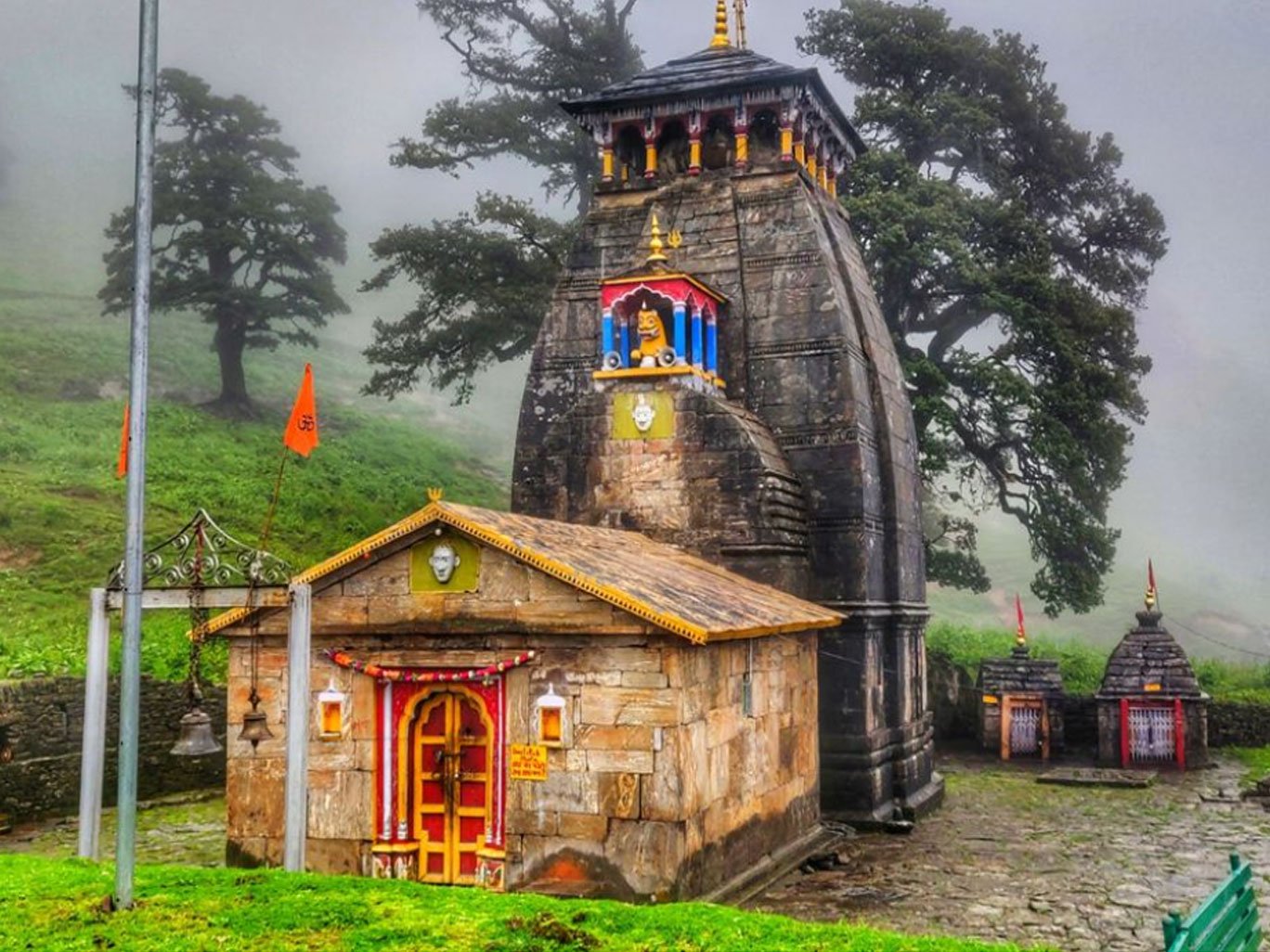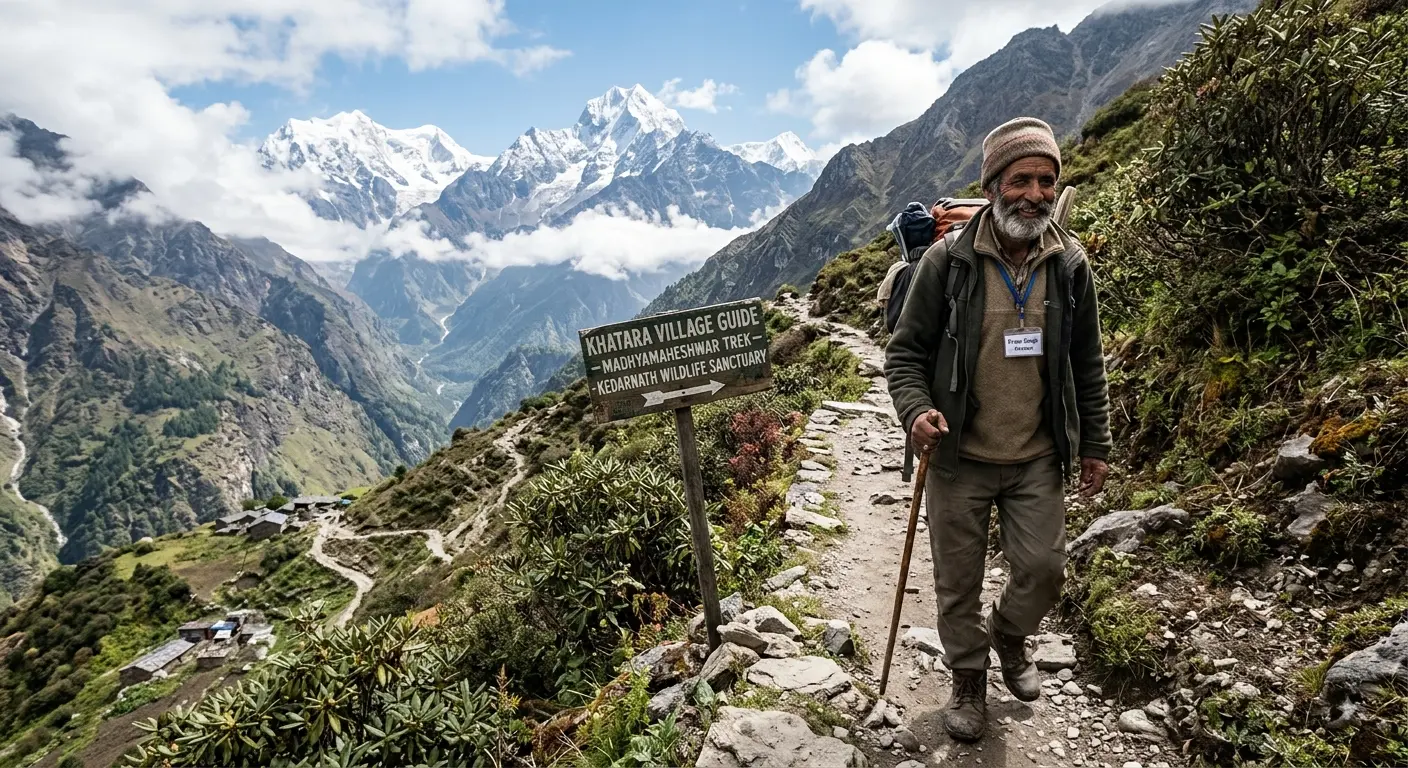
Khatara Village is a small mountain settlement and trail stop on the upper section of the Madhyamaheshwar trek in Rudraprayag, Uttarakhand.
Trekkers encounter Khatara after progressing beyond Gaundar and Bantoli, as the trail begins moving away from the lower forested valley toward the higher terrain leading to Madhyamaheshwar Temple.
Unlike Ransi, which serves as the roadhead, or Gaundar, which is a more established intermediate village stop, Khatara is much smaller and has limited facilities. Its importance comes primarily from its location on the trekking route and the transition in landscape that travelers begin to notice around this section.
Khatara is a small trail settlement encountered after the Bantoli section while travelling toward the upper Madhyamaheshwar route. It is best treated as a route landmark and rest point rather than a developed tourist destination.
For the complete Ransi–Gaundhar–Bantoli–Khatara–Nanu route, see our Madhyamaheshwar Trek Route Guide.
Khatara Village Quick Facts
Information | Details |
|---|---|
Village | Khatara Village |
District | Rudraprayag |
State | Uttarakhand |
Route | Madhyamaheshwar Trek |
Access | Trekking only |
Previous Important Stop | Bantoli |
Next Route Section | Nanu and upper Madhyamaheshwar trail |
Road Access | No direct road access |
Accommodation | Very limited; do not depend on it |
Food | Seasonal/basic refreshments may be available |
Mobile Network | Unreliable |
Best Time | Generally May–June and September–October |
Known For | Small Himalayan trail settlement and rest point |
Where Is Khatara Village?
Khatara Village lies on the trekking route leading from the lower Madhyamaheshwar valley toward the main temple.
The broader journey begins from Ransi Village, the primary roadhead for the trek.
From Ransi, travelers move deeper into the valley through intermediate settlements and trail points before eventually reaching Bantoli. Khatara appears farther along the uphill route after Bantoli and before the final approach toward Madhyamaheshwar.
This position makes Khatara useful as a geographic reference when trekkers are judging their progress on the more demanding half of the journey.
Khatara should not be confused with Ransi or Gaundar. Each settlement occupies a different position and serves a different practical purpose on the trail.
Why Is Khatara Important on the Madhyamaheshwar Trek?
Khatara is important because it marks a noticeable stage in the transition from the lower trekking valley toward the higher terrain surrounding Madhyamaheshwar.
The lower sections of the route contain thicker forest, river valleys, and more established village stops.
As trekkers progress beyond Bantoli and toward Khatara, the route continues climbing and gradually begins to feel more remote.
The settlement itself is small, but it can provide a useful point to stop, recover, drink water, check the weather, and assess your energy before continuing.
Gaundar, Bantoli and Khatara: Understanding the Sequence
Understanding the order of settlements makes the Madhyamaheshwar route much easier to plan.
A simplified trail sequence is:
Ransi → Gaundar → Bantoli → Khatara → Nanu → Upper Trail → Madhyamaheshwar
Gaundar Village is one of the important settlements encountered earlier in the trek.
Bantoli follows farther along the route and is associated with the lower valley and river-confluence area.
Khatara comes after this section as travelers begin progressing farther uphill.
The key distinction is simple:
Gaundar is a significant village halt, Bantoli is an important route and confluence-area landmark, and Khatara is a smaller upper-trail settlement and rest point.
Keeping these places separate prevents confusion when planning daily distances and overnight stops.
Bantoli to Khatara Village Trek
The section after Bantoli becomes increasingly important from a pacing perspective.
The trail continues uphill through Himalayan forest and mountain terrain, and travelers who felt comfortable during the earlier part of the journey may notice that progress becomes slower as the climbing increases.
Khatara provides a useful psychological landmark on this section.
Rather than trying to complete the climb as quickly as possible, maintain a steady pace.
Take short breaks when required, drink water regularly, and keep enough energy for the remaining ascent.
Different travel resources report slightly different kilometer measurements for individual segments of the Madhyamaheshwar trail. For that reason, it is better to use Khatara as a route landmark rather than relying on an exact kilometer count when making safety decisions.
For a broader route breakdown covering Ransi, Gaundar, Bantoli, Khatara, Nanu, and the temple approach, see this Madhyamaheshwar route and travel guide.
What Is Khatara Village Like?
Khatara is not a conventional tourist village.
Do not expect large guesthouses, cafés, shops, or organized sightseeing attractions.
The settlement is small and closely connected with the trekking route.
Depending on the season, travelers may encounter a few local structures, simple rest facilities, or basic refreshments serving pilgrims and trekkers passing through.
The surroundings are more important than commercial infrastructure.
Forest, mountain slopes, narrow trails, open sections of sky, and changing Himalayan vegetation define the experience.
This simplicity is part of Khatara's appeal.
For many trekkers, it is one of those small places remembered not because of a famous monument, but because it arrives at exactly the point where tired legs need a pause.
Facilities in Khatara Village
Facilities at Khatara are limited and should never be treated as guaranteed.
Depending on the pilgrimage season and local operations, travelers may find:
A basic tea or refreshment point
Drinking-water access nearby
A simple place to rest
Limited shelter during changing weather
Local information about the trail ahead
However, trekkers should not depend on Khatara for:
ATMs
Reliable digital payments
Pharmacies
Medical facilities
Large food stores
Reliable mobile connectivity
Hotel-style accommodation
Extensive trekking equipment
Purchase essential supplies before entering the trail.
Is Accommodation Available in Khatara?
Khatara should not be your primary accommodation plan unless you have confirmed a current local option before traveling.
Facilities along remote Himalayan trekking routes can open or close depending on season, pilgrimage traffic, weather, and local circumstances.
If your itinerary requires a planned overnight halt, use more established accommodation points instead of assuming that a room will be available in Khatara.
Our Madhyamaheshwar Trek Accommodation Guide covers the main stay options along the wider route.
Carry enough daylight margin to reach your intended confirmed stop safely.
Food and Water at Khatara
Seasonal tea stalls or basic refreshments may occasionally be available around Khatara during the active trekking period, but availability should not determine your safety plan.
Carry your own drinking water and some lightweight energy food.
Useful trekking snacks include:
Nuts
Dry fruit
Energy bars
Bananas when available
Biscuits
Electrolyte sachets
Do not wait until you are exhausted or extremely hungry before eating.
Small amounts of food at regular intervals can help maintain energy during a sustained climb.
If refilling water from a natural source, use appropriate purification or filtration when necessary rather than assuming every source is automatically safe.
How Difficult Is the Trail Around Khatara?
The difficulty around Khatara comes more from cumulative fatigue and continuous climbing than from technical mountaineering.
By the time trekkers reach this section, they have already covered a considerable amount of mountain terrain.
Heavy backpacks, insufficient hydration, poor sleep, changing weather, and an overly fast pace can make the upper route significantly harder.
Travelers preparing before the journey can follow our 30-Day Madhyamaheshwar Trek Fitness Plan.
Fitness training should focus on walking endurance, leg strength, uphill movement, and the ability to continue comfortably for several hours.
Landscape Around Khatara
One of the most rewarding aspects of progressing toward Khatara is the gradual change in the surrounding landscape.
The trail begins moving away from the feeling of the lower valley.
Forest cover can become less enclosed as travelers gain height, and portions of the surrounding Himalayan terrain become more visible when weather conditions are clear.
TourMyHoliday's Khatara coverage similarly describes this area as a transition between denser forest and more open upper terrain.
Do not assume that snow peaks will always be visible.
Clouds can move into the valley quickly, particularly during unstable or wet weather.
The experience of Khatara is therefore as much about the changing vegetation and atmosphere as distant mountain views.
Best Time to Pass Through Khatara Village
Khatara is normally visited as part of the accessible Madhyamaheshwar trekking season.
May to June
Late spring and early summer are among the commonly preferred periods for the pilgrimage.
The route generally becomes more accessible after winter, while temperatures are more manageable than during colder periods.
Mountain weather can still change rapidly.
July to August
The monsoon period requires much greater caution.
Rain can make stone pathways and soil slippery, reduce visibility, increase stream flow, and affect road access before you even reach Ransi.
Anyone considering this period should review our Madhyamaheshwar Monsoon Trek Guide.
September to October
Post-monsoon conditions can offer clearer views and fresh green landscapes when the weather remains stable.
Temperatures become progressively colder as the season advances.
The official Uttarakhand Tourism Panch Kedar Circuit should also be checked when planning the broader pilgrimage route. Uttarakhand Tourism identifies Madhyamaheshwar as part of the Panch Kedar circuit and provides official route context for the pilgrimage.
Khatara Village During Monsoon
Khatara's forested mountain surroundings can appear especially green during monsoon, but this is not a reason to underestimate trail conditions.
Wet terrain changes the trek substantially.
Watch for:
Slippery stones
Muddy sections
Reduced visibility
Sudden rain
Stronger stream flow
Falling debris on unstable slopes
Delays caused by road conditions farther down the valley
Never continue simply because another group has gone ahead.
Local conditions can change within a short period.
If residents, guides, forest personnel, or authorities advise trekkers to stop, follow their instructions.
Mobile Network Around Khatara
Continuous mobile connectivity should not be expected.
As you move farther from road-connected settlements, network availability can become intermittent or disappear completely.
Before starting the trek:
Download useful information offline.
Screenshot important bookings.
Save emergency contacts.
Tell family members that you may be unreachable.
Carry a fully charged power bank.
Keep important identification protected from rain.
A phone should be a useful tool, not the only element of your safety plan.
What to Carry for the Khatara Section
By the time you reach Khatara, everything you are carrying has already traveled several kilometers with you.
Pack carefully.
Recommended essentials include:
Comfortable trekking shoes with reliable grip
Drinking water
Energy snacks
Lightweight warm layers
Rain protection
Personal medicines
Basic first-aid supplies
Sunscreen
Sunglasses
Cap
Trekking poles if useful
Power bank
Cash
Headlamp
Small waste bag
Avoid carrying unnecessary equipment simply because it appears on generic trekking lists.
The most useful backpack is one that contains everything essential without becoming unnecessarily heavy.
Safety Tips for Khatara and the Upper Trail
Khatara lies on a section where fatigue can influence decision-making.
A few simple precautions make a significant difference.
Start your trekking day early.
Maintain a pace at which you can still speak comfortably rather than repeatedly pushing yourself to exhaustion.
Drink water before becoming extremely thirsty.
Take short controlled breaks instead of long stops that allow your body to cool excessively.
Avoid walking alone after dark.
Keep an eye on changing cloud conditions.
Never stand close to exposed edges simply for photographs.
If someone in your group develops severe or persistent symptoms such as dizziness, unusual breathlessness, vomiting, confusion, or difficulty walking normally, do not ignore them.
For other avoidable planning errors, read Common Mistakes That Make the Madhyamaheshwar Trek Harder.
Can Families and Older Travelers Cross Khatara?
Age alone does not determine whether someone can complete this section.
Fitness, previous trekking experience, health, weather, pace, and recovery matter much more.
Children and older travelers who are comfortable with sustained mountain walking may be able to complete the route, while poorly prepared younger adults may struggle.
Families should build additional time into the itinerary and avoid aggressive distance targets.
Our Madhyamaheshwar Trek Guide for Families, Kids and Seniors explains these considerations in greater detail.
Responsible Travel in Khatara
Remote trail settlements have limited waste-management capacity.
Anything carried into Khatara should ideally leave with you unless a proper disposal system is clearly available.
Do not leave:
Plastic bottles
Food wrappers
Wet wipes
Batteries
Disposable raincoats
Religious packaging
Avoid loud music and respect local residents.
Ask permission before photographing people or private homes.
Do not damage plants or create shortcuts across fragile slopes.
Use existing trails rather than widening the path unnecessarily.
Responsible trekking protects both the local environment and the experience of future pilgrims.
From Khatara to Madhyamaheshwar
Khatara is not the end of the day's mountain environment.
The trail continues beyond the settlement toward the higher route and eventually the Madhyamaheshwar temple area.
As altitude increases, the character of the landscape continues changing from forested trail toward more open Himalayan terrain.
Do not rush this section simply because the destination feels close.
Arrival time depends on pace, weather, trail conditions, rest breaks, and individual fitness.
Once travelers have completed the main pilgrimage, those with suitable weather and energy can consider the additional hike described in our Budha Madhyamaheshwar Temple Guide.
Khatara Village FAQs
Where is Khatara Village?
Khatara Village is a small settlement on the upper Madhyamaheshwar trekking route in Rudraprayag district, Uttarakhand. It is encountered after the Bantoli section while traveling toward Madhyamaheshwar.
Is Khatara on the Madhyamaheshwar trek route?
Yes. Khatara is one of the small settlements or trail stops encountered on the route toward Madhyamaheshwar.
Can you reach Khatara Village by road?
No. Khatara is reached on foot as part of the Madhyamaheshwar trekking route.
What comes before Khatara?
Bantoli is the important route point encountered before the Khatara section when traveling toward Madhyamaheshwar.
What comes after Khatara?
The trail continues toward Nanu and the higher sections leading toward Madhyamaheshwar.
Are shops available in Khatara?
Seasonal basic refreshments or tea facilities may operate, but travelers should not depend on guaranteed shop availability.
Can I stay overnight in Khatara?
Accommodation is very limited and should not be assumed. Plan overnight stays around confirmed accommodation rather than relying on an unverified Khatara option.
Is mobile network available in Khatara?
Mobile connectivity can be unreliable or unavailable. Keep important information accessible offline.
Is the Khatara section difficult?
The challenge mainly comes from sustained uphill trekking and accumulated fatigue from earlier parts of the route. Fitness, backpack weight, weather, and pacing strongly affect difficulty.
What is the best time to visit Khatara?
May–June and September–October are generally more favorable trekking periods than peak monsoon, subject to current weather, temple-season access, and local trail conditions.
Final Thoughts
Khatara Village is easy to overlook when looking at the Madhyamaheshwar route on a map.
It does not have the roadhead importance of Ransi, the village-stop role of Gaundar, or the religious significance of Madhyamaheshwar Temple. Yet that is exactly why Khatara deserves to be understood properly. It is one of the small Himalayan settlements that helps divide a demanding pilgrimage into recognisable stages. For tired trekkers climbing beyond Bantoli, reaching Khatara can provide both a practical rest point and a clear sense of progress toward the upper valley. Travel with realistic expectations. Do not depend on extensive facilities. Carry the supplies you need, respect residents, monitor the weather, and preserve enough energy for the trail that remains ahead.
Khatara may be a small stop on the Madhyamaheshwar journey, but for those walking the route step by step, it becomes part of the experience that makes this pilgrimage memorable.